
In a few days, on July 6, one of the most hyped-up movie premieres will take place in London. Guests have received invitations but the location remains a secret. Several trailers have been released, but film critics have yet to view the movie. However, one aspect of the film that director Christopher Nolan did not manage to keep secret was publicly revealed one year ago: in July of 2025, Nolan and his team, including Matt Damon, Zendaya and Charlize Theron popped up filming in Dakhla, a city in the non-self-governed territory of Western Sahara under illegal Moroccan military occupation since 1975 whose original peoples, the Sahrawi, are heavily repressed by Moroccan forces and have been systematically expelled as part of Morocco’s attempts to disappear them from their homeland.
Dakhla, a stunning peninsula with sparking white sand on the southern tip of Western Sahara, is also the Moroccan occupation’s “crown jewel”, used by the regime to promote and normalise its presence and exploitation through tourism, sporting events, film and cultural festivals and international film shoots like Nolan’s The Odyssey. During the filming of The Odyssey, Moroccan Minister of Culture, Mehdi Bensaid, took selfies with Nolan and later said in an interview that “obviously, this film shoot will give visibility to Dakhla as a film location and not just a tourist destination”, adding that “thanks to its worldwide distribution, this film will make Dakhla and Morocco known to people unfamiliar with the region and our country”.
Meanwhile, Sahrawis from Dakhla are imprisoned if they speak out against the occupation and Morocco’s plunder of their homeland. Those attempting to make their own films about life under occupation are threatened, persecuted and forced out of the territory.
For the past year, FiSahara (Western Sahara International Film Festival) has sought a response from Nolan, Syncopy and Universal: why did they choose this location, are they aware of Morocco’s brutal repression against the Sahrawi people and will they edit the stolen scenes into the film without the consent of the rightful owners of the White Sand Dune where they were filmed? The latest film trailer released on July 1st, appears to include, in its opening scene, a shot of the beach in occupied Dakhla.
Despite FiSahara’s campaign last year supported by film stars and activists including Javier Bardem, Pedro Almodóvar, Greta Thurnberg and many others asking Nolan to leave Western Sahara and not use the scenes shot there, as well as extensive media coverage by over one hundred media outlets, including Variety, Hollywood Reporter, Deadline and The Guardian whose journalists attempted to get a response from the film’s makers, Nolan, Syncopy and Universal have chosen to remain silent for the past year, so FiSahara is joining the Sahrawi people in calling for a general boycott of the film.
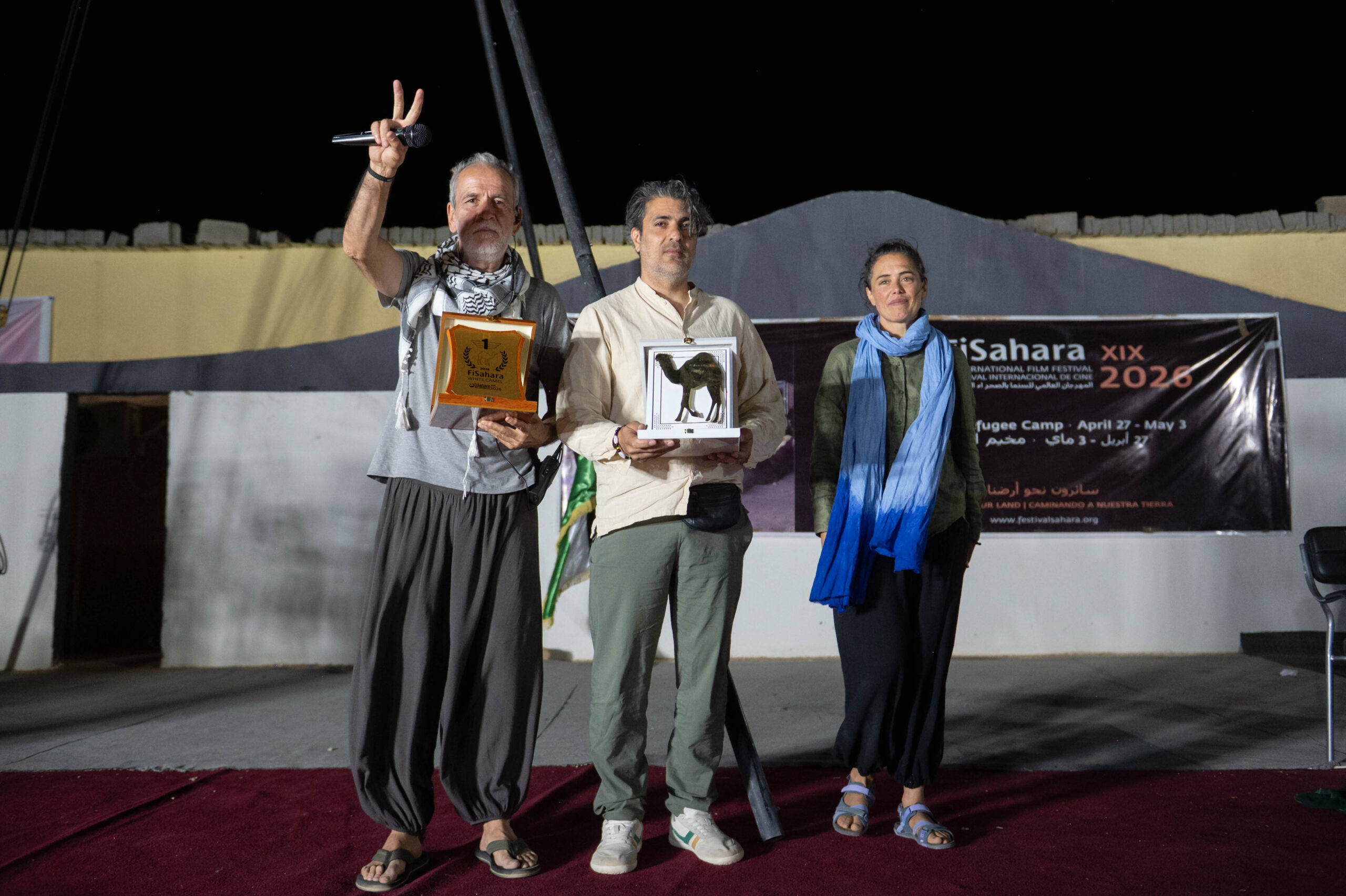
“When Christopher Nolan steps on the red carpet on his way to the premiere’s screening, he will also be stepping on International Law, specifically the right of the Sahrawi people to their territory and resources, which are being illegally exploited by Morocco, and of Sahrawis to make their own films there without fear of imprisonment”, said María Carrión, Executive Director of FiSahara, whose most recent edition in April of 2026 was dedicated to the Right of Return. “This one-year silence amounts to a deliberate choice to be complicit to Morocco’s illegal and brutal occupation of Western Sahara. The Sahrawi people continue to suffer from enforced displacement, land grabbing and forced exile amounting to ethnic cleansing, as Morocco tries to implement its settler colonial project and make the occupation permanent. We ask the public to treat this film as they would a movie made in occupied Ukraine with Putin’s permits, or in the illegal settlements in Palestine with Netanyahu’s blessings”.
“Christopher Nolan has had one year to learn about the land from which my family was forced to flee in 1975 under white phosphorus bombs”, said Sahrawi filmmaker Brahim Chagaf, whose short film Toufa portrays the exodus of thousands of Sahrawis into exile in Algeria during the Moroccan military invasion. “I grew up in the Sahrawi refugee camps in Algeria and today, as a Sahrawi filmmaker from the occupied city of Dakhla, I cannot freely enter my homeland to tell my own stories. That is the great contradiction behind this landscape: while a few privileged people like Nolan can turn it into a movie, others are still waiting for the day when we can simply return to it”.
Film star Javier Bardem, whose 2012 documentary film Sons of the Clouds examines the unwillingness of major world powers to decolonize Western Sahara and end Morocco’s occupation, added “I would encourage Mr. Nolan to understand the history of the Moroccan regime’s repression against the Sahrawi people and its systematic human rights violations against Sahrawis living under its illegal occupation, which are documented by organisations such as Amnesty International and many others. I made a film about Western Sahara years ago; this is a deeply personal issue for me”.
FiSahara is also calling on media covering The Odyssey’s opening not to ignore the fact that part of it was filmed in an illegally occupied territory whose people have suffered 50 years of repression and exile, as documented by numerous international organisations, scores of UN human rights reports and media coverage such as the Democracy Now! documentary Four Days Inside Morocco Occupied Western Sahara: Africa’s Last Colony.
As The Odyssey’s Ulysses sought to return to Ithaca and recover his homeland, the Sahrawi people seek to return to Western Sahara through a long-promised UN referendum on self-determination long being blocked by Morocco and its main Western allies led by Trump’s White House, which illegally recognises Morocco’s sovereignty over Western Sahara. But as The Daily Beast recently reported, Sahrawis will not give up until they return.
Other Relevant Links:
Fifty Years in Exile: Human Rights and the Forgotten Crisis in Western Sahara (Human Rights Program, Harvard Law School)
Freedom House: Western Sahara
RSF Report: Western Sahara, A News Blackhole
UN: Western Sahara Peoples’ Self-Determination at Risk (Human Rights Watch)